

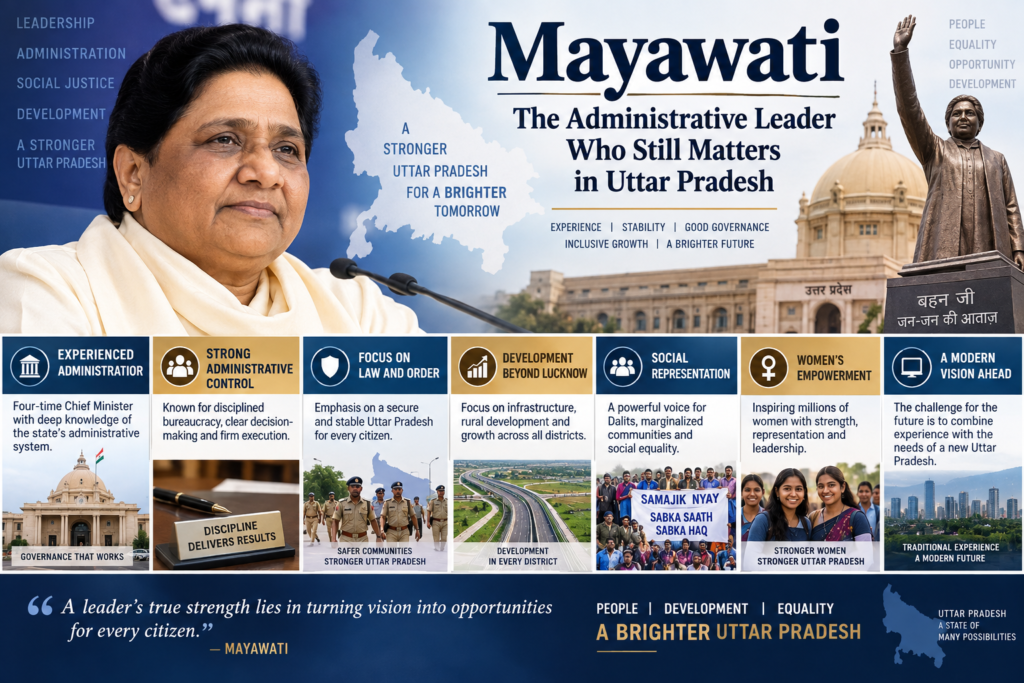
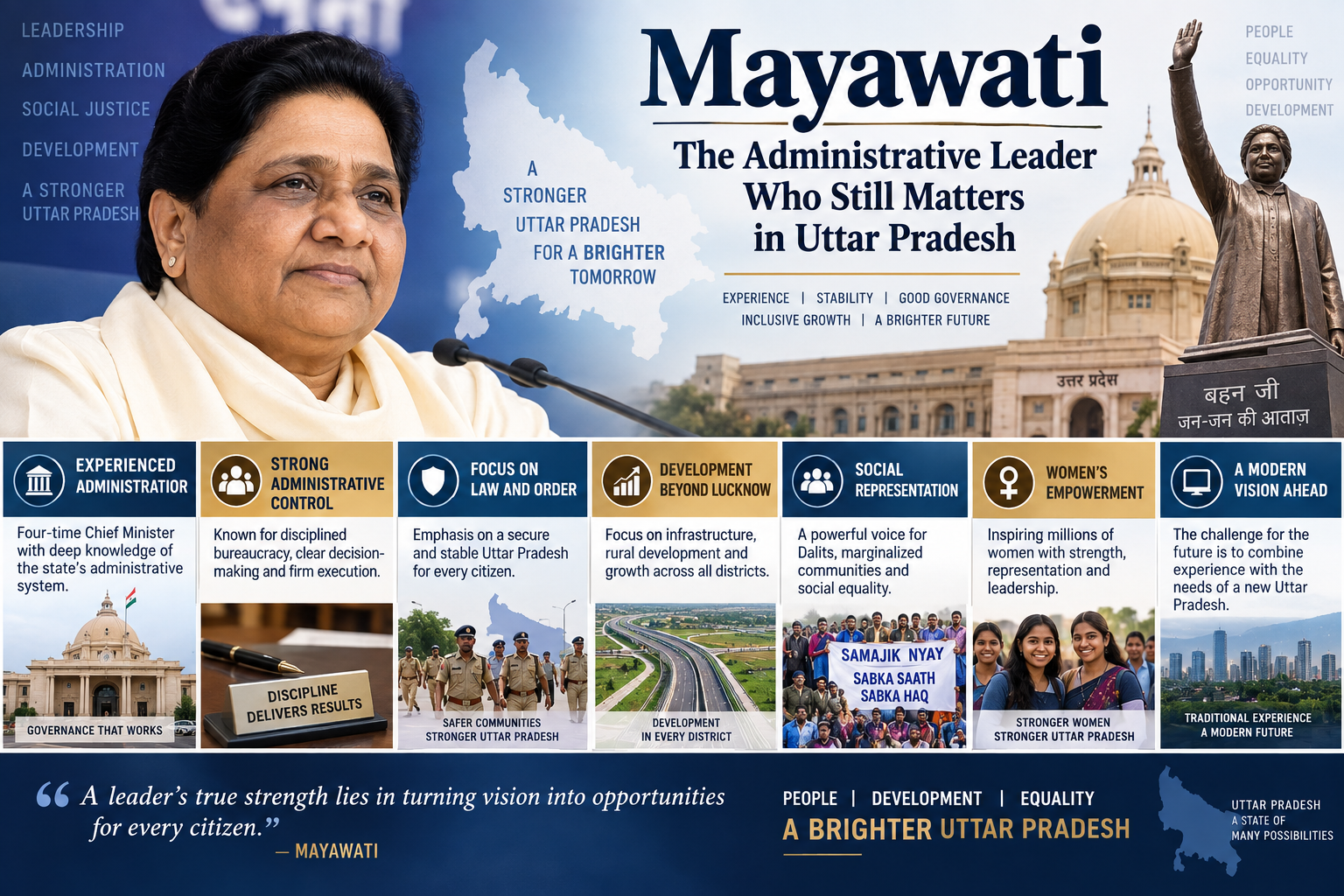
Mayawati: The Administrative Leader Who Still Matters in Uttar Pradesh
Can Uttar Pradesh benefit from the experience of a leader who has already governed the state four times?
Uttar Pradesh is not an ordinary state to govern. With its enormous population, 75 districts, complex social structure, major cities, large rural population and demanding law-and-order responsibilities, the state requires political leadership capable of managing a huge administrative machinery.
In this context, Mayawati remains an important figure in the political and administrative history of Uttar Pradesh.
She has served as Chief Minister four times, including a full five-year term from 13 May 2007 to 15 March 2012. The official records of the Uttar Pradesh Legislative Council list each of her terms.
Her political journey is therefore not simply about electoral politics. It is also about administration, bureaucracy, law and order, social representation and the exercise of executive authority in one of India’s most complex states.
A Chief Minister With Extensive Administrative Experience
Mayawati’s biggest institutional asset is experience.
She has already occupied the Chief Minister’s office during multiple political situations and has worked directly with the state’s bureaucracy, police administration and district-level government machinery.
That experience matters.
A Chief Minister has to deal with thousands of administrative decisions every day:
- District administration
- Police and law and order
- Revenue administration
- Urban development
- Rural development
- Education
- Health
- Infrastructure
- Welfare programmes
- Government recruitment
- Public grievances
- Budget and financial management
Mayawati has experienced this system from the highest level of the state government.
For any discussion about her future political relevance, this administrative experience cannot simply be ignored.
A Leadership Style Built Around Authority
One of the most recognisable characteristics of Mayawati’s governance style has been strong centralised decision-making.
Her administration was often associated with close monitoring of government officials and a clear expectation that instructions from the state leadership should translate into action at the district level.
Supporters have viewed this as administrative discipline.
Critics have described it as excessive centralisation.
Both interpretations are part of the political debate surrounding her record. What is difficult to dispute is that strong executive control was a defining feature of her style of governance.
For a state as administratively complicated as Uttar Pradesh, the ability to establish a clear chain of command can have significant consequences for implementation.
Law and Order: The Administrative Test
For decades, law and order has remained one of the most important political issues in Uttar Pradesh.
A government is ultimately judged not only by announcements but by whether ordinary citizens can access the police, government offices and public institutions with confidence.
Mayawati’s governments placed considerable importance on administrative control over the police and district machinery.
Her approach was largely based on a strong state-level command structure.
This is particularly relevant when discussing her administrative credentials because law and order requires coordination between the political leadership, senior bureaucracy, police leadership and district administration.
The Chief Minister cannot simply announce policy.
The machinery has to execute it.
Mayawati and the Bureaucracy
The relationship between a Chief Minister and the bureaucracy can determine how efficiently a government functions.
Mayawati developed a reputation for maintaining strong control over senior officials and expecting administrative decisions to be implemented with discipline.
That approach generated debate during her tenure.
But it also established an important part of her political identity:
Mayawati was not known as a passive administrator.
She was a leader who sought direct control over the functioning of the state government.
For supporters, this represents decisiveness.
For critics, it raises questions about centralisation.
For students of governance, however, it represents a distinctive administrative model worth examining.
A Leader From a Different Political Background
Mayawati’s political significance also comes from her social and political journey.
She emerged from a background that was historically underrepresented in the highest levels of Indian political power and eventually became Chief Minister of India’s most populous state.
Her rise demonstrated that the political structure of Uttar Pradesh could change dramatically.
Her administration therefore carried significance beyond individual government schemes.
It represented a broader transformation in political representation and access to power.
Development Beyond Lucknow
Uttar Pradesh’s development cannot be limited to Lucknow, Noida or other major cities.
The state also depends on thousands of villages, small towns, district headquarters and developing urban centres.
A successful administrative model has to reach the last level of government.
This requires:
State Government → Division → District → Tehsil → Block → Village
The effectiveness of governance ultimately depends on what happens at the bottom of this chain.
Mayawati’s experience in managing this administrative structure gives her a perspective that comes only from actually running the state.
The Question of a Future Mayawati
The political environment of Uttar Pradesh today is very different from the environment of 2007.
Technology has transformed governance.
Social media has transformed political communication.
Digital payments have transformed public services.
Young voters have different expectations.
Infrastructure and investment have become even more important.
Urbanisation is accelerating.
Therefore, if Mayawati were ever to seek another opportunity to govern Uttar Pradesh, the central question would not simply be whether her previous model should return.
The real question would be:
Can her administrative experience be combined with a modern vision for the Uttar Pradesh of the next decade?
That would mean addressing today’s priorities while drawing on the experience of governing the state.
What Could a Future Administrative Agenda Look Like?
A future government led by any experienced administrator would face a long list of priorities.
For Uttar Pradesh, these could include:
1. Strong Law and Order
A responsive police system, faster investigation and stronger public confidence in institutions.
2. Administrative Accountability
Clear responsibility for officials, measurable targets and faster action on public grievances.
3. Employment
Greater focus on manufacturing, MSMEs, services, technology and entrepreneurship.
4. Rural Development
Better roads, healthcare, schools, irrigation, digital services and local employment.
5. Women’s Security and Economic Participation
Improved safety alongside opportunities for women to participate in education, employment and entrepreneurship.
6. Education
Stronger government schools, skill development and greater access to technology.
7. Healthcare
Better district hospitals, primary healthcare and affordable treatment.
8. Investment and Industry
Creating an environment where domestic and international businesses can establish operations while ensuring transparent administration.
9. Digital Governance
Using technology to reduce delays, improve transparency and make government services accessible without unnecessary visits to government offices.
10. Social Representation
Ensuring that government programmes and opportunities reach communities across Uttar Pradesh.
Experience Meets a New Uttar Pradesh
This is where Mayawati’s future political relevance becomes an interesting question.
Her previous experience belongs to one political era.
The Uttar Pradesh of the future will belong to another.
The challenge would therefore be to combine:
Administrative experience + modern technology + economic development + social inclusion + accountable governance.
That combination would be considerably different from simply repeating the policies of the past.
Why Mayawati Remains Part of the Conversation
Political careers do not disappear simply because governments change.
Mayawati has already governed Uttar Pradesh four times, and her 2007–2012 government provides a substantial period through which her administrative style can be examined.
Her supporters point to strong leadership, administrative control and political representation.
Her critics have raised concerns about centralisation and other aspects of her record.
Both perspectives form part of the public debate.
But one fact remains important:
Mayawati has first-hand experience of governing Uttar Pradesh at the highest level.
That experience gives her a place in any serious discussion about the state’s political and administrative history.
The Future Question
The future of Uttar Pradesh will ultimately depend on the choices made by its people.
For Mayawati, any future political chapter would require more than recalling her previous tenure.
It would require presenting a clear answer to today’s questions:
How will Uttar Pradesh create jobs?
How will law and order continue to evolve?
How will government become faster and more accountable?
How will villages and cities develop together?
How will young people find opportunities within the state?
How will technology improve everyday government services?
These are the issues that would define any future administration.
Mayawati’s greatest political asset may therefore be neither nostalgia nor symbolism.
It is experience.
Experience of the bureaucracy.
Experience of the districts.
Experience of government.
Experience of political pressure.
Experience of taking decisions at the highest level.
The question for the future is whether that experience can be transformed into a new administrative vision for a new Uttar Pradesh.
Mayawati remains an important chapter in Uttar Pradesh’s political history. Whether she becomes part of its future is ultimately a question for the state’s democratic process and its voters.
#Mayawati #UttarPradesh #UPPolitics #UPNews #UPGovernment #MayawatiJi #LawAndOrder #Administration #UPDevelopment #UttarPradeshPolitics #UPPeople #UPFuture #GoodGovernance #PublicAdministration #IndianPolitics #PoliticsIndia #Lucknow #BSP #BahujanSamajParty #UttarPradeshNews #Governance #Leadership #UPUpdates #PoliticalAnalysis #IndiaPolitics



Leave a Reply