

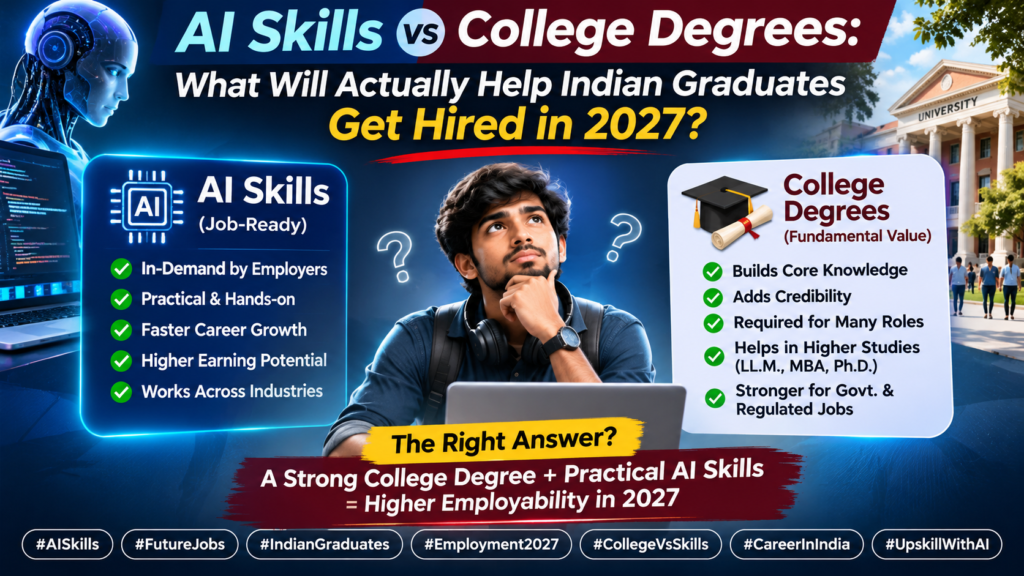
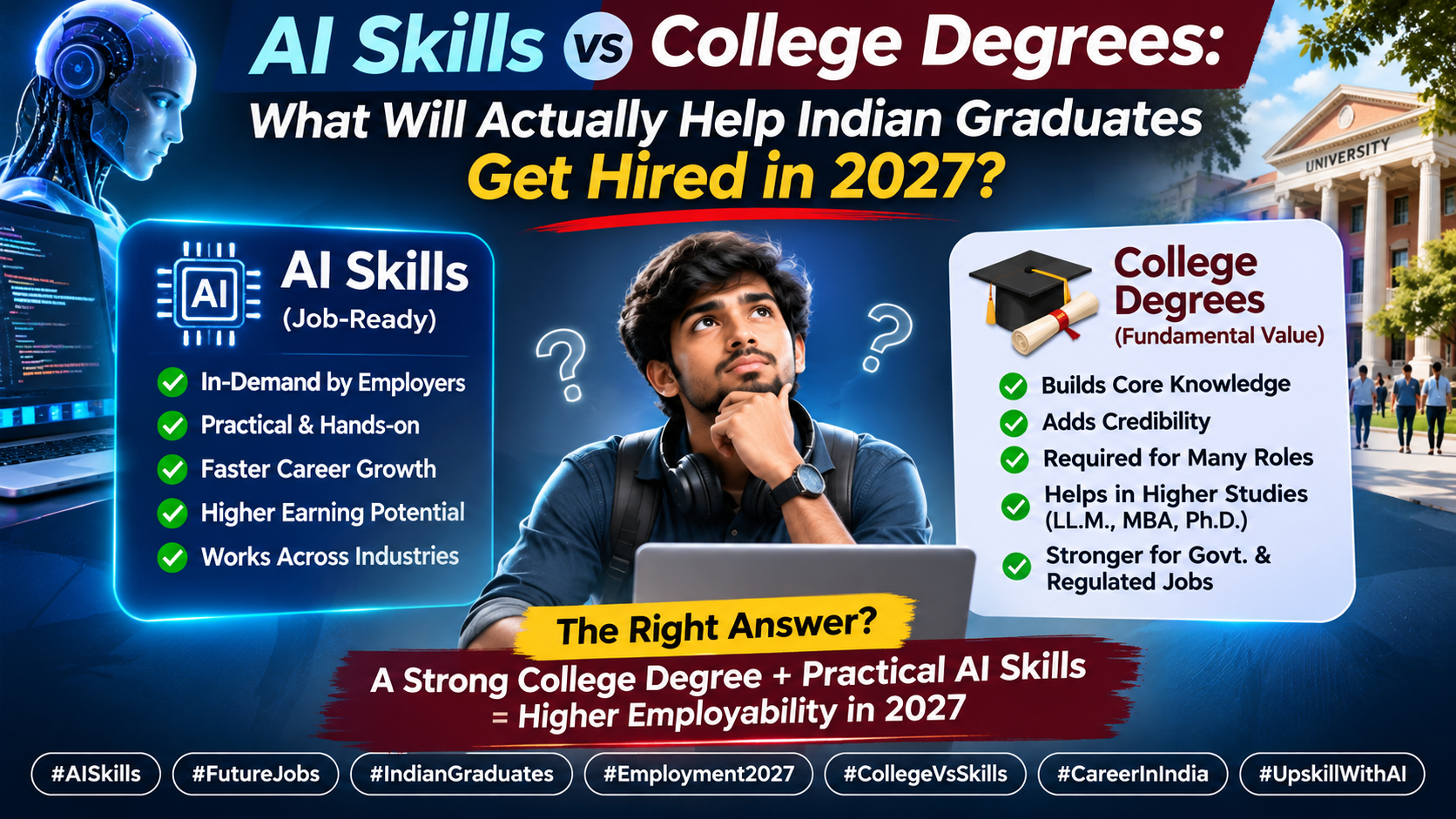
AI Skills vs College Degrees: What Will Actually Help Indian Graduates Get Hired in 2027?
By SochtaBharat Editorial Team | Category: Education & Careers
Imagine two graduates applying for the same entry-level job.
One has a college degree and good examination results but has never worked on a real project. The other has learned practical tools, completed a few projects and can explain how those projects solve a problem.
Who should get the job?
The answer depends on the role. Some employers need a recognized qualification. Others place greater emphasis on practical ability, communication, analytical thinking and relevant experience. Increasingly, candidates need to demonstrate more than one of these strengths.
For Indian students planning their careers in 2027, this creates an important question: should you focus on earning a degree, learning artificial intelligence (AI) skills, or combining the two?
The practical answer is to build both a credible educational foundation and job-relevant skills, wherever your chosen career requires them. The right balance depends on your budget, career target, current qualifications and the requirements of employers in your field.
What is changing in India’s job market?
The transition from education to employment remains a challenge for many young Indians. More people are gaining access to higher education, but having a qualification does not automatically guarantee a suitable job.
Azim Premji University’s State of Working India 2026 examines this transition from education into employment. Its findings highlight a crucial distinction: graduates generally earn more than non-graduates over their working lives, but financial barriers and insufficient growth in graduate employment continue to create difficulties.
Source: Azim Premji University, State of Working India 2026.
At the same time, employers are adapting their recruitment practices to changing technology and business needs.
Deloitte India’s Campus Workforce Trends 2026, published on 27 August 2026, reported that 86% of surveyed organisations said AI or agentic AI was transforming recruitment processes. It also found that 35% of organisations reported AI adoption was creating new entry-level roles or skill requirements, up from 21% in FY25.
These figures come from Deloitte’s survey of 257 organisations and 505 campuses. They should not be interpreted as a measurement of every employer in India.
Source: Deloitte India, Campus Workforce Trends 2026.
The direction is clear: students need to understand not only what they study, but also how they can apply that knowledge to real work.
College degree vs AI skills: A practical comparison
| Factor | College degree | Practical AI and job skills |
| Main value | Structured education and a recognized qualification | Ability to perform specific tasks and solve practical problems |
| Learning approach | Curriculum, classes, assessments and examinations | Hands-on practice, projects and targeted training |
| Time commitment | Usually several years, depending on the qualification | Varies from short courses to years of practice |
| Cost | Tuition, accommodation, travel and other expenses | Course fees, equipment, software and learning time |
| Employer requirements | Essential or preferred for many professions and graduate roles | Useful where skills and demonstrated ability match the role |
| Evidence of ability | Qualification, marks and relevant academic work | Projects, assessments, portfolios, experience and demonstrations |
| Limitations | A qualification alone may not demonstrate job readiness | Skills alone may not satisfy qualification requirements or prove deep competence |
| Long-term value | Builds foundations and can support progression into specialized fields | Needs regular updating as tools, tasks and business requirements change |
Neither route guarantees employment. A strong candidate understands the requirements of the chosen occupation and builds the right evidence of competence.
Why a degree still matters
It is tempting to assume that AI tools will make college education unnecessary. That conclusion is too broad.
- Some professions require formal qualifications
Fields such as medicine and regulated legal practice have formal educational and professional requirements. Certain engineering, teaching, government and specialist roles also specify particular qualifications or eligibility criteria.
A short AI course cannot replace a legally required degree, license or professional credential.
Before selecting a course, check the official eligibility requirements for the career you want.
- A degree can build foundations that take time to develop
Computer science students, for example, may study programming, algorithms, databases, operating systems and mathematics. These foundations can help them understand why a solution works, not just which button to press in a tool.
Similarly, a commerce graduate who understands accounting principles may be better equipped to identify errors in an AI-generated financial summary than someone who knows how to generate the summary but lacks accounting knowledge.
The qualification is most valuable when the student develops genuine understanding alongside it.
- College can provide access to opportunities
Depending on the institution, students may gain access to laboratories, faculty guidance, internships, alumni networks, campus recruitment and collaborative projects.
These opportunities are not equally available at every college. Students should investigate placement outcomes, course quality, fees and employer connections rather than relying on a college’s reputation alone.
The real question is not whether degrees matter. It is whether the degree you choose provides enough educational and career value for its cost.
Why practical skills and AI knowledge matter
A qualification can establish your educational background, but employers also need to understand what you can actually do.
- AI tools are becoming part of different jobs
AI is no longer relevant only to people who build machine-learning systems.
Depending on the occupation, workers may use AI-assisted tools for research, document preparation, coding, data analysis, customer support, design or administrative tasks.
The useful skill is not simply knowing the name of an AI tool. It is knowing how to apply it to a task, evaluate its output, identify errors and protect confidential information.
- Projects provide evidence of ability
Suppose you are applying for an entry-level data analyst role.
Instead of listing only an AI certificate, you could build a project that:
- Uses a publicly available dataset.
- Cleans and organizes the data.
- Analyzes trends using a spreadsheet or suitable programming tools.
- Presents findings in a clear dashboard.
- Explains the limitations of the analysis.
The project gives a recruiter something concrete to evaluate.
However, a portfolio does not guarantee an interview or offer. The quality of the work and its relevance to the position still matter.
- Employers still need human judgment
Technical tools cannot eliminate the need to understand a problem correctly, communicate with colleagues, make responsible decisions or recognize when an answer is unreliable.
Deloitte India’s 2026 campus hiring research identifies learning agility, adaptability, collaboration and role-specific capabilities among the qualities employers increasingly value.
Students should therefore combine technical learning with communication, analytical thinking and the ability to learn unfamiliar tasks.
What does the latest hiring evidence tell us?
A useful comparison is to examine the changing demands of graduate recruitment alongside the continuing value of higher education.
Deloitte India’s 2026 research reported that AI and data capabilities attracted pay premiums of 20–25% in the surveyed campus talent landscape. The report also described internships as an increasingly important pathway to full-time employment.
These findings indicate that specialized skills and relevant experience can differentiate candidates. They do not mean every person who learns AI will earn a 20–25% higher salary. The reported premium relates to the roles and comparisons covered by the survey.
Meanwhile, the State of Working India 2026 report emphasizes that graduates generally earn more than non-graduates, even though the transition into employment remains difficult.
Taken together, the evidence argues against treating education and skills as competing investments.
A degree may help a candidate qualify for a role. Practical ability can help demonstrate readiness to perform it. Neither is a substitute for checking the actual requirements of the job.
Which combination works best for different careers?
The right learning plan depends on your target profession.
Information technology and software development
A relevant degree can provide valuable technical foundations, particularly for roles that require computer science knowledge.
Alongside formal education, students can learn programming, databases, version control, testing, cloud fundamentals and responsible AI-assisted development.
A useful portfolio project might be a small web application with authentication, a database and documented testing. The goal is to demonstrate that you understand the system, not merely that AI generated some code.
Data analysis and business intelligence
Students can focus on spreadsheets, SQL, statistics, data visualization and business problem-solving. Python or AI-assisted analysis may be useful additions, depending on the target role.
A good project explains the question being investigated, the data used, the method, the findings and the limitations.
Commerce, accounting and finance
A commerce or finance qualification can provide the necessary domain foundation for many roles.
Practical additions might include advanced spreadsheets, accounting software, data interpretation, financial reporting and carefully supervised use of AI for routine tasks.
Accuracy, confidentiality and regulatory requirements remain important.
Design, marketing and content
Students can develop writing, visual design, audience research, analytics and digital marketing skills while learning appropriate AI-assisted workflows.
A portfolio should show the problem, the intended audience, the creative decisions and the results where measurable.
AI-generated output without clear reasoning or a relevant portfolio may not distinguish a candidate from other applicants.
Government and regulated careers
Always check the relevant recruitment notification, examination rules, eligibility criteria and professional requirements.
A degree, recognized qualification or license may be mandatory. Practical AI skills can support preparation or later work, but they cannot override official eligibility rules.
How should students choose where to invest their money?
A costly degree is not automatically better than an affordable one, and an expensive AI course is not automatically better than a free learning resource.
Before paying for either, compare the likely benefits against the total cost.
| Question | What to investigate |
| Is the qualification required? | Check official eligibility requirements and real job advertisements. |
| What will the complete course cost? | Include tuition, living expenses, travel, equipment and lost earning time. |
| Does the course teach relevant skills? | Review the syllabus, teaching quality, practical work and assessment methods. |
| Are employment claims credible? | Ask for transparent placement data, cohort sizes, job roles and salary definitions. |
| Can you demonstrate your learning? | Look for projects, supervised practice, internships or other credible evidence. |
| Is the skill useful beyond one tool? | Prioritize transferable concepts and the ability to learn new systems. |
For students with limited budgets, a sensible approach may be to pursue an affordable, recognized qualification where needed while learning relevant practical skills through free or low-cost resources.
Avoid taking on substantial debt solely because a course provider promises a high salary or guaranteed placement without verifiable evidence.
A practical six-month career preparation plan
You do not need to master every AI tool before applying for jobs. Start with one target occupation and build the capabilities that matter for it.
Month 1: Select a target role
Choose one or two related job titles. Review current job advertisements and note recurring qualifications, tools, technical skills and experience requirements.
Separate mandatory requirements from desirable ones.
Month 2: Build the foundations
Learn the essential concepts for your chosen role. Use structured courses, textbooks, official documentation or other credible resources.
If the occupation requires a formal qualification, plan your education accordingly.
Month 3: Practice with real tasks
Work through realistic exercises rather than only watching tutorials. Use AI as a learning assistant where appropriate, but check its answers and make sure you understand the work yourself.
Month 4: Complete a project
Build one useful project related to your target role. Document the problem, method, decisions and limitations. Use legitimate data and respect privacy and copyright.
Month 5: Seek feedback and experience
Ask a teacher, mentor, experienced professional or relevant community to review your work. Apply for suitable internships, projects, apprenticeships or entry-level opportunities where available.
Month 6: Prepare for recruitment
Practice explaining your projects, solving role-specific problems and answering interview questions. Improve your CV, apply for appropriate roles and use feedback to identify skill gaps.
Review your progress at the end of the six months. If the evidence shows that you need deeper technical knowledge, more practice or an additional qualification, adjust your plan.
Five mistakes students should avoid
Mistake 1: Collecting certificates without building competence.
A certificate can document learning, but you should be able to demonstrate what you learned.
Mistake 2: Assuming AI will eliminate the need for education.
Formal qualifications remain essential in many occupations, and foundational knowledge helps people use AI responsibly.
Mistake 3: Choosing a degree only because of social pressure.
Investigate the career options, course quality, cost and entry requirements before committing.
Mistake 4: Believing every AI course promises a high-paying career.
Check the curriculum, instructor credentials, independent reviews and verifiable employment outcomes.
Mistake 5: Ignoring communication and problem-solving.
The ability to explain your reasoning, collaborate and identify mistakes can be important alongside technical skills.
Frequently asked questions
Can I get a job in India without a college degree if I know AI?
Some roles may accept candidates without a degree if they can demonstrate the required skills. Other positions require formal qualifications. Check individual job advertisements and eligibility rules before deciding to skip college.
Is an AI certificate enough to get a job in 2027?
Usually, a certificate alone is weak evidence of practical competence. Its value depends on what you learned, how it was assessed and whether the skills match the position. Projects, relevant experience and demonstrable problem-solving can strengthen an application.
Which AI skills should students learn first?
Start with basic AI literacy: understanding what AI can and cannot do, writing clear instructions, checking outputs and protecting sensitive information. Then select role-specific tools and technical skills based on real job requirements.
Should students learn AI before choosing a career?
It is useful to understand AI’s capabilities, but students should first identify their interests, strengths and potential career paths. They can then choose relevant AI skills rather than learning tools without a clear purpose.
Is a degree still worth the cost?
It can be, particularly when the qualification is required or provides strong educational and professional opportunities. Compare the total cost, course quality, career options and realistic alternatives before making the decision.
Final verdict: Build a career, not just a résumé
The debate between AI skills and college degrees creates a false choice for many students.
A degree can provide foundational knowledge, a recognized qualification and access to opportunities. Practical skills can demonstrate that you can apply knowledge to real problems. Internships, projects, communication and continued learning can strengthen both.
The best route is not identical for everyone. A future doctor, a software developer, a graphic designer and an aspiring government employee face different requirements.
Before investing in a course, ask three questions:
- What qualifications does my target career actually require?
- What practical abilities will employers expect me to demonstrate?
- How can I prove those abilities without spending more than I can reasonably afford?
Answer those questions honestly, then build a learning plan around them.
For students preparing for 2027, the strongest strategy is to choose education deliberately, develop practical skills consistently and learn to use AI critically rather than relying on it blindly.
That approach will not guarantee a job, but it can help you make better decisions and present stronger evidence of your capabilities to potential employers.
Sources and further reading
- Azim Premji University: State of Working India 2026
- Deloitte India: Campus Workforce Trends 2026
- Google Search Central: Creating helpful, reliable, people-first content
Editorial note: Hiring trends and job requirements change. Check current vacancies and official eligibility rules before making educational or career decisions.
Are college degrees enough to secure a good job? Or are practical AI skills becoming essential?
Explore how education, AI knowledge and real-world experience can shape the future of Indian graduates.
Read the full article on SochtaBharat.
#AI #AISkills #FutureOfJobs #IndianGraduates #Employment2027 #CollegeVsSkills #CareerInIndia #ArtificialIntelligence #FutureSkills #DigitalIndia #SkillDevelopment #HigherEducation #JobMarket #CareerGrowth #UpskillWithAI #SochtaBharat

Leave a Reply