

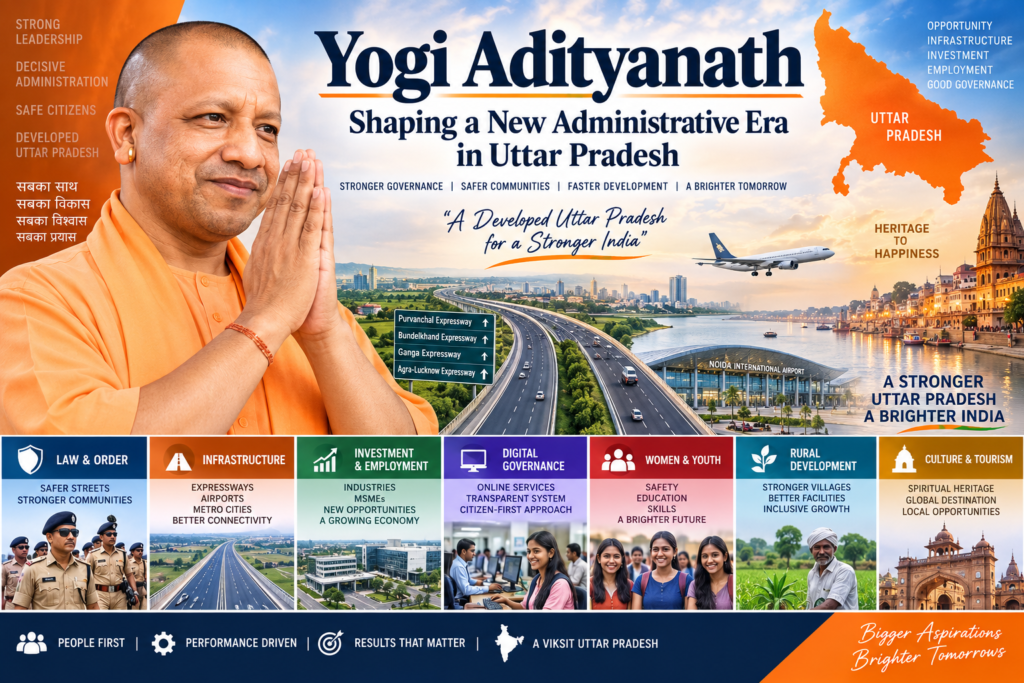
Yogi Adityanath: The Administrative Leader Who Still Matters in Uttar Pradesh
From Political Leadership to an Administrative Model
Uttar Pradesh is a state where the scale of government itself is a challenge.
With 75 districts, a population of more than 200 million people, one of India’s largest police forces and an enormous network of state institutions, effective administration requires more than political direction. It requires coordination, execution, monitoring and continuity.
Since becoming Chief Minister in 2017, Yogi Adityanath has developed a distinctive administrative style centred on strong executive control, law and order, infrastructure, investment and implementation.
The Uttar Pradesh Legislative Assembly currently lists him as Chief Minister and Leader of the House, while the official Council of Ministers page shows that he directly holds a large portfolio of departments, including Home, Personnel, Revenue, Vigilance, General Administration, Infrastructure, Planning and Law & Legislative Affairs.
That concentration of responsibility is an important part of understanding his administrative model.
A Leadership Style Focused on Execution
One of the defining features of Yogi Adityanath’s government has been the emphasis on converting government decisions into implementation.
The administration has repeatedly highlighted monitoring, timelines, district-level reviews and direct accountability of officials.
This approach creates a clear chain:
Chief Minister → Government Departments → District Administration → Local Implementation → Citizen
For a state as large as Uttar Pradesh, this chain is critical.
Policies can look impressive on paper, but their real impact depends on whether they reach districts, towns and villages.
The administrative challenge is therefore not simply making decisions.
It is making decisions happen.
Law and Order as a Core Administrative Priority
Law and order has remained one of the central themes of Yogi Adityanath’s administration.
The state government describes its approach as a policy of zero tolerance toward crime and has highlighted policing reforms, the expansion of the police commissionerate system, cyber-police infrastructure, forensic capabilities and specialised security institutions.
The government has reported that commissionerate systems have been implemented in several major urban districts and that cyber police stations have been established across the state.
Whether one agrees with every aspect of the government’s approach or not, law and order has clearly been placed near the centre of its administrative agenda.
The Infrastructure Push
Another major part of the Yogi administration’s story is infrastructure.
Expressways, airports, metro systems, industrial corridors and urban infrastructure have become major components of the state’s development strategy.
In March 2026, the Uttar Pradesh government highlighted seven operational expressways, additional expressways under development, 16 operational airports and metro services in seven cities as part of its development record.
Infrastructure matters because it creates the physical foundation for economic activity.
A better road network can reduce travel time.
Airports can improve connectivity.
Industrial infrastructure can attract investment.
Urban transport can change how people move through cities.
The larger objective is to make Uttar Pradesh more connected and economically integrated.
Administration and Investment
A modern state government is also expected to function as an economic facilitator.
Uttar Pradesh has increasingly positioned itself as an investment destination, with the state government’s Invest UP platform operating as an institutional mechanism for investment promotion.
The government has reported substantial investment projects and a large MSME base as part of its economic-development narrative. These are government-reported figures and should be assessed alongside independent economic data.
The administrative challenge here is significant.
Investment does not happen because of announcements alone.
It requires:
- Land and infrastructure
- Electricity
- Roads and connectivity
- Approvals
- Skilled workers
- Law and order
- Regulatory coordination
- Reliable government services
That makes economic development partly an administrative execution problem.
Digital Governance and a Changing State
Uttar Pradesh is also moving toward a more technology-driven model of governance.
Digital platforms, online citizen services, dashboards, cyber-policing and data-based monitoring are becoming increasingly important parts of government administration.
The state’s Sewa Mitra platform, for example, describes its mission around digitally connecting skilled professionals with citizens and institutions.
This is an important transition.
The traditional model of governance often required citizens to repeatedly visit government offices.
The emerging model aims to move more services toward:
Mobile → Online Platform → Digital Verification → Government Service
For a state with such a large population, digital governance could become one of the most important administrative tools of the coming decade.
The District Is Where Governance Becomes Real
Lucknow can make a policy.
But the district has to deliver it.
The real test of administration happens in places such as:
Gorakhpur, Varanasi, Kanpur, Prayagraj, Agra, Meerut, Lucknow, Bareilly, Ayodhya and thousands of smaller towns and villages.
This is where government decisions meet ordinary citizens.
A strong Chief Minister therefore needs an administrative system capable of translating state-level decisions into district-level results.
Yogi Adityanath’s governance model has placed considerable emphasis on monitoring this implementation chain.
Infrastructure + Law and Order + Administration
The broader picture becomes clearer when these areas are viewed together.
A state cannot attract major investment without infrastructure.
Infrastructure cannot operate effectively without law and order.
Law and order cannot function without an effective police and administrative system.
And none of these systems can deliver consistently without bureaucratic coordination.
This creates an interconnected governance model:
Strong Administration
↓
Better Implementation
↓
Infrastructure & Connectivity
↓
Investment & Employment
↓
Improved Public Services
That is the administrative framework associated with the Yogi era.
A New Generation of Uttar Pradesh
The Uttar Pradesh of the future will be very different from the Uttar Pradesh of the past.
The state is becoming increasingly urban.
Young people are demanding jobs and entrepreneurship.
Businesses want faster approvals.
Citizens expect digital services.
Cities need modern transport.
Villages need better connectivity.
Industries need skilled workers.
And government institutions need to become faster and more transparent.
The next stage of governance will therefore require more than traditional political administration.
It will require data, technology, infrastructure and institutional capacity.
The Challenge Ahead
Strong administrative authority can accelerate decision-making, but authority alone does not guarantee successful governance.
The long-term test is whether government institutions become:
More efficient.
More accountable.
More transparent.
More accessible.
More responsive.
The real legacy of any administration is ultimately measured by what remains after individual decisions and political headlines have passed.
For Uttar Pradesh, that means asking practical questions:
- Did government services become easier to access?
- Did infrastructure improve connectivity?
- Did investment translate into productive economic activity?
- Did employment opportunities expand?
- Did citizens experience better public services?
- Did law-and-order institutions become more capable?
- Did district administration become more responsive?
These are measurable questions, and they matter more than political slogans.
Why Yogi Adityanath Still Matters in the Administrative Story of UP
Yogi Adityanath’s tenure has created a distinctive chapter in Uttar Pradesh’s governance history.
His administration has placed law and order, infrastructure, investment, digital governance and strong executive monitoring at the centre of its governing approach. Official state records continue to show him as Chief Minister, with significant administrative portfolios under his direct charge.
Supporters point to stronger enforcement, infrastructure expansion and administrative decisiveness.
Critics have raised questions about aspects of the government’s policies and methods.
For a serious assessment, both the government’s claims and independent evidence need to be examined.
But one thing is clear:
Yogi Adityanath has become a significant figure in the administrative evolution of modern Uttar Pradesh.
His larger legacy will ultimately depend not only on the decisions made during his tenure, but on whether the institutions, infrastructure and administrative systems developed during this period continue to deliver results in the years ahead.
The Bigger Vision
Uttar Pradesh is no longer simply competing within India for political attention.
It is increasingly competing for:
Investment.
Industries.
Talent.
Jobs.
Infrastructure.
Technology.
Global economic opportunities.
The state’s future will depend on how effectively its government can convert its enormous population into an economic and human-capital advantage.
That requires administrative leadership capable of thinking beyond five-year political cycles.
The real measure of leadership is not the size of the announcement.
It is the scale of implementation.
And that is ultimately where the administrative legacy of Yogi Adityanath will be judged.
A stronger administration.
A more connected Uttar Pradesh.
A more competitive economy.
And a state prepared for the next generation.
#YogiAdityanath #UttarPradesh #YogiAdityanathJi #UPGovernment #UttarPradeshNews #UPNews #UPPolitics #Lucknow #Development #GoodGovernance #StrongLeadership #Administration #LawAndOrder #Infrastructure #DigitalGovernance #UPDevelopment #NewUttarPradesh #ViksitUP #UttarPradeshDevelopment #IndiaDevelopment #Governance #Leadership #PublicAdministration #YouthOfUP #UPYouth #InvestInUP #MakeInUP #Expressways #Noida #Ayodhya #Varanasi #Gorakhpur #BJP #YogiGovernment #YogiModel #UPModel #IndianPolitics #PoliticsIndia #IndianGovernance #TrendingIndia
#GoodGovernance #Administration #LawAndOrder #Infrastructure #DigitalGovernance
#UPNews #UPPolitics #IndiaDevelopment #IndianPolitics #TrendingIndia




Leave a Reply